 One simple method. Notice it. Name it. DropIT.
Your Mind Has Three Gates
Every thought you’ve ever had entered through one, stayed in one, and left through one. Here’s how to manage all three. By Emmanuel OpokuYour mind is not a filing cabinet. It’s a pipeline. Thoughts don’t just appear and disappear — they travel. They enter, settle, and exit. And each stage of that journey is where you either lose control or gain it.
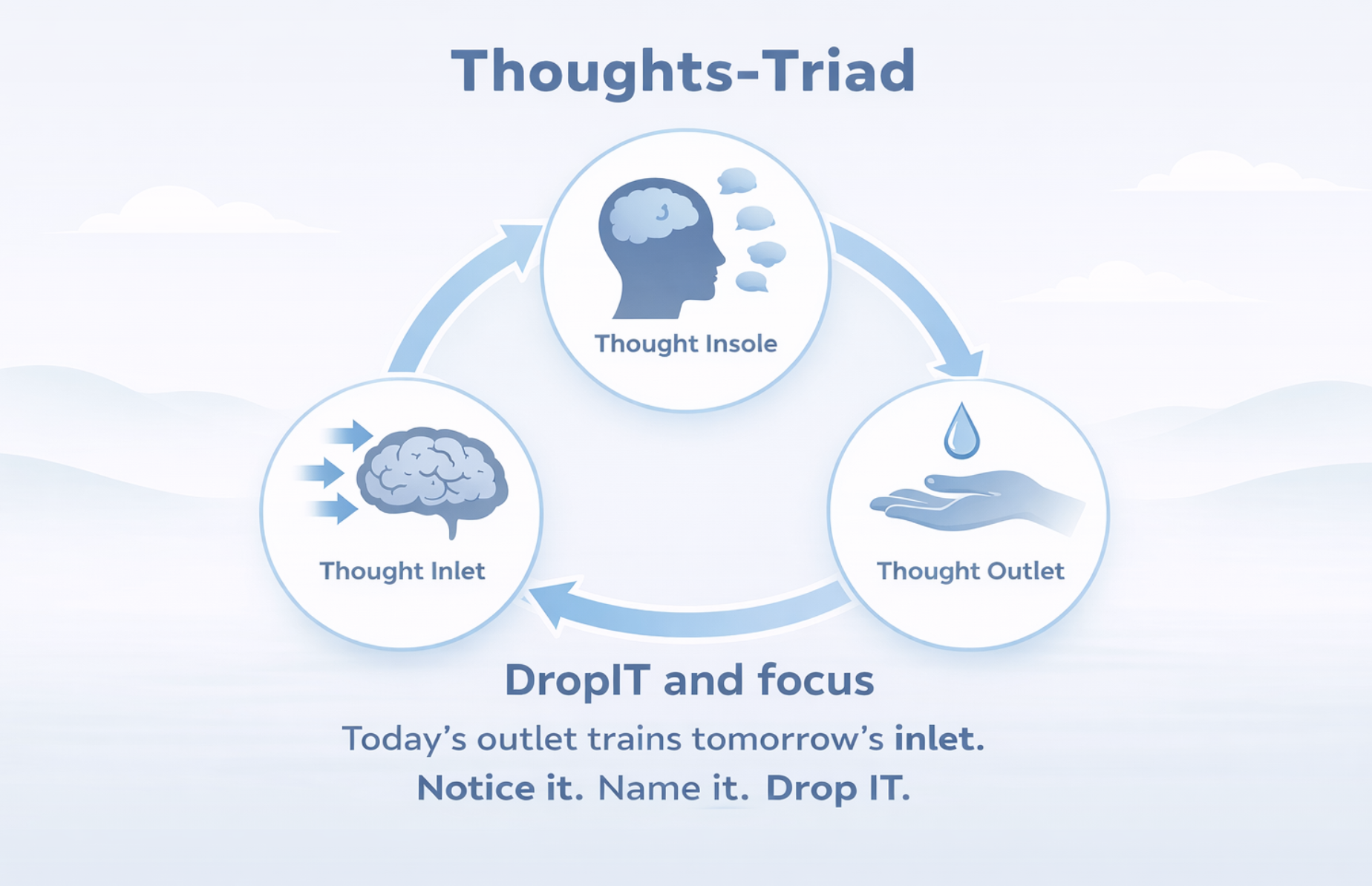
This is what the Thoughts-Triad is about.
Three stages. One flow. And a simple method for managing all of it.
Where thoughts enter. Triggered by something outside you — or inside you.
Where thoughts live. The inner layer where they settle, repeat, and grow.
Where thoughts leave — through action, speech, release, or avoidance.
Gate 1 — The Inlet
How thoughts get in
Every thought has a trigger. A news headline. A smell. A memory. A moment of pain or shame or hunger.
The brain is always scanning — and it’s biased toward threat. Fear, guilt, comparison, and uncertainty are the fastest ways in. That’s not a flaw. It’s survival wiring.
But when you’re stressed, sleep-deprived, or overstimulated — the inlet becomes a flood gate. Everything gets through.
The first skill isn’t managing thoughts. It’s noticing what opens the door.
What helps at this stage: reducing unnecessary triggers, protecting sleep, limiting overstimulating content, and building one simple habit — pausing before a thought gains momentum.
Gate 2 — The Insole
Where thoughts take root
Most thoughts pass. Some don’t.
A thought stays when attention feeds it — when the mind keeps returning, replaying, questioning, or judging. That’s when a passing worry becomes rumination. A fleeting image becomes obsession.
This is where the brain’s default mode network — the part responsible for self-talk and inner narrative — can work against you. Left unchecked, it loops.
Trying to force a thought out often makes it worse. Research on thought suppression shows that brute-force resistance causes rebound. The thought comes back louder.
The goal isn’t to evict every thought. It’s to decide which ones deserve to stay.
The right question here: Is this thought true, useful, and timely — or is it just occupying space?
Gate 3 — The Outlet
How thoughts leave
Thoughts don’t just vanish. They exit — and how they exit matters.
A thought spoken repeatedly becomes identity. A thought acted on becomes habit. A thought ritualized — checked, reassured, avoided — becomes stronger, not weaker. The brain learns: this thought matters.
The healthiest outlets are the simplest: act on it calmly if it’s useful. Write it down if it needs processing. Release it without ceremony if it doesn’t serve you.
The worst outlet for most intrusive thoughts is compulsive reassurance — endlessly googling, checking, replaying. That response trains the brain to keep the alarm ringing.
The Loop That Changes Everything
These three stages don’t work in isolation. They loop.
What you rehearse inside tends to come out. What comes out trains what gets in next time. Every calm response to an intrusive thought teaches the brain: this doesn’t need to be a crisis.
That’s neuroplasticity in real life. Not positive thinking. Repeated practice, one response at a time.
The DropIT Questions
At the Inlet — when a thought arrives
What triggered this? Does it deserve my attention right now?
At the Insole — when a thought won’t leave
Is this thought looping, warning, accusing, or planning? Is it true, useful, and timely?
At the Outlet — when it’s time to let go
Should this leave through action, expression, or release? Will my response strengthen peace — or strengthen the loop?
You don’t only need to ask “What am I thinking?”
You need to ask “Where is this thought in its journey?”
Once you know that — you can manage it.DropIT.
The mind is trainable. One thought, one gate, one drop at a time.
DropIT.